

INTRODUCTION
Human resource development is like a flower in bloom to be experienced and difficult to describe. Behind performance are individuals and behind results are people. HRD has been widely accepted as one of the most effective tools for overall development of the organization. Now in India most of the developing organizations have either opened a separate HRD department or in the process of opening it. To give a feel of the actual practice and demonstration of HRD in organizations we have taken up actual cases of several public and private sector organizations. Written by executives of these organizations. Integrated HRD systems were first introduced in India in Larsen and Toubro.Larsen & Toubro Limited, commonly known as L&T, is one of the largest Indian multi-national firms and leading construction company in India headquartered in Mumbai, Maharashtra, India.It was founded by two Danish engineers taking refuge in India. The company has business interests in engineering, construction, manufacturing goods, information technology, and financial services, and has offices worldwide.
History
Larsen & Toubro originated from a company founded in 1938 in Mumbai by two Danish engineers, Henning Holck-Larsen and Søren Kristian Toubro. The company began as a representative of Danish manufacturers of dairy equipment. However, with the start of the Second World War in 1939 and the resulting restriction on imports, the partners started a small workshop to undertake jobs and provide service facilities. Germany’s invasion of Denmark in 1940 stopped supplies of Danish products. The war-time need to repair and refit ships offered L&T an opportunity, and led to the formation of a new company, Hilda Ltd, to handle these operations. L&T also started to repair and fabricate ships signalling the expansion of the company. The sudden internment of German engineers in British India (due to suspicions caused by the Second World War), who were to put up a soda ash plant for the Tata’s, gave L&T a chance to enter the field of installation.
In 1944, ECC was incorporated by the partners; the company at this time was focused on construction projects (Presently, ECC is the construction division of L&T). L&T began several foreign collaborations. By 1945, the company represented British manufacturers of equipment used to manufacture products such as hydrogenated oils, biscuits, soaps and glass. In 1945, the company signed an agreement with Caterpillar Tractor Company, USA, for marketing earth moving equipment. At the end of the war, large numbers of war-surplus Caterpillar equipment were available at attractive prices, but the finances required were beyond the capacity of the partners. This prompted them to raise additional equity capital, and on 7 February 1946, Larsen & Toubro Private Limited was incorporated.
After India’s independence in 1947, L&T set up offices in Calcutta (now Kolkata), Madras (now Chennai) and New Delhi. In 1948, 55 acres of undeveloped marsh and jungle was acquired in Powai, Mumbai. A previously uninhabitable swamp subsequently became the site of its main manufacturing hub. In December 1950, L&T became a public company with a paid-up capital of ₹20 lakh (US$28,000). The sales turnover in that year was ₹1.09 crore (US$150,000). In 1956, a major part of the company’s Mumbai office moved to ICI House in Ballard Estate, which would later be purchased by the company and renamed as L&T House, its present headquarters.
During the 1960s, ventures included UTMAL (set up in 1960), Audco India Limited (1961), Eutectic Welding Alloys (1962) and TENGL (1963).
HUMAN RESOURCE DEVELOPMENT IN LARSEN AND TOUBRO LIMITED
Larsen and toubro limited is probably the first organization in India to introduce and integrated HRD system and to set a separate Human Resources Development Department, headed by a senior executive to implement the system. The whole exercise of looking into the human resource system was mainly due to the culture of excellence, introspection, and openness in the company. Constructive criticism and periodical reviews are common to ensure maximum mileage from a system or an operation.
The performance appraisal system existing in 1974 which was of a confidential nature and one way affair was not considered effective. The assessments were not discussed and in many cases very little use was made of the data generated from the appraisals. Therefore, L & T management requested Dr. Udai Pareek and Dr. T.V. Rao of the Indian institute of management, Ahmedabad, to conduct a study on the performance appraisal system with the following objectives–
- To review the objectives of the appraisal system existing at that time and to examine the extent ti which the data collected contributed to these objectives.
- To prepare characteristics of a good appraisal system in L& T.
- To examine the feasibility of adopting these characteristics.
- To examine the reactions of the persons who use the appraisal forms- both subordinates and superiors.
- To determine the consequential actions to be taken in the light of improvements needed and for the implementation of a new system, if evolved.
- To determine the skills required for making the system effective and operative (ie. Feedback counselling, etc.) and the manner of building and developing such skills.
Integrated HRD system
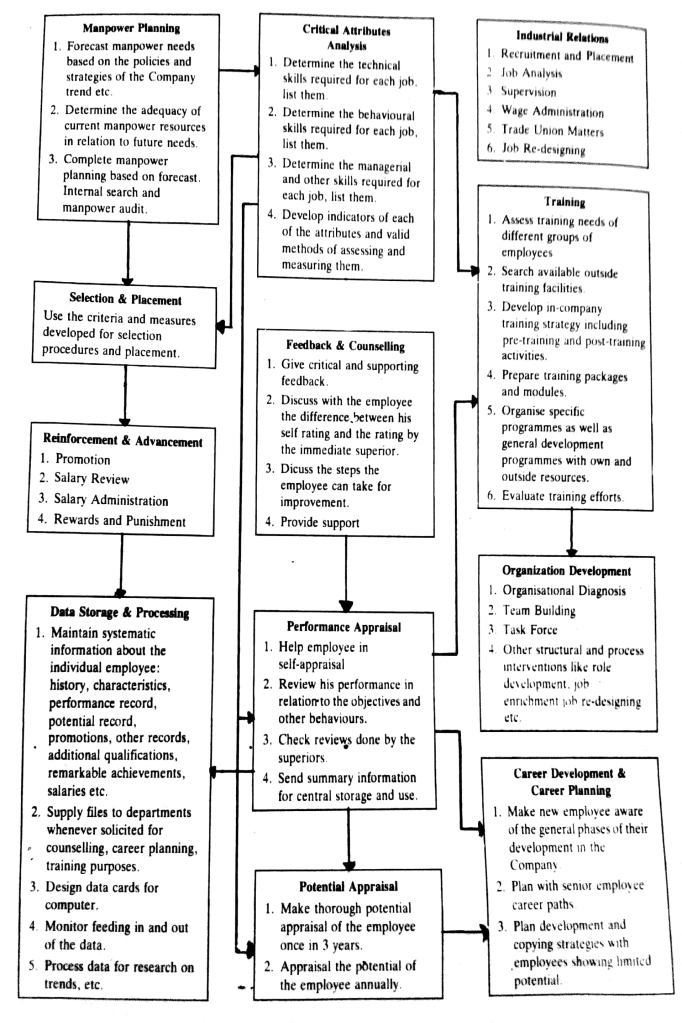
The IIMA team presented a report not only on performance appraisal but on other interrelated sub- subsystems and included the following-
- Performance appraisal
- Potential appraisal
- Employee counselling
- Career development and planning
- Training
- Organization development
A schematic presentation of the system recommended by them is shown in the attached annexure.
The professors further recommended that the system be implemented “in toto” to obtain the synergic benefits. It was proposed to implement the various sub- systems in a phased manner, over a period of five to seven years.
Implementation
The implementation was entrusted to a task force of senior executives and started with the induction of a new performance appraisal system in 1975. Although the original framework of the integrated HRD system has remained the same, the details have been modified from time to time as per the feedback received and experience gained. The question of gaining the maximum mileage from the system has been the uppermost in the mind.
Performance Appraisal and Feedback
Performance appraisal has always a dual approach, viz, evaluation approach and development approach. One without the other makes the appraisal ineffective. However, the relative emphasis can be different. It was felt that the performance appraisal will have a heavy leaning towards the development of the employees and the evaluation to a greater degree can be taken care of by the performance appraisal system. It was also assumed that the relationship between the superior and the subordinate is very crucial for the development.
The essentials of the new performance appraisal system are-
- Performance appraisal is shifted to a line responsibility rather than to a personnel function activity.
- It calls for goal setting by appraiser and appraise together.
- It requires appraisal interviews and counselling and feedback in an interaction session with openness. The immediate superior is required to enter his rating at that time of the interview.
Before introducing the new appraisal system a number of training programmes were conducted for explaining the system as well as for providing skills for receiving and giving feedback which is one of the most important aspects of the system. The progress of implementation was constantly monitored through feedbacks and studies and difficulties faced were removed. As a result of this the form and the system has been considerably simplified. Around 80 % to 85% of the forms are received within six weeks after the target date which is an acceptable level considering the time required for counselling.
The forms are analysed and data submitted to the vice- presidents and general managers. The date gives the rating of high performers, and persons rated low. Another set of data give the facilitating and hindering factors group wise. These are used for finalising development and other action plans.
Difficulties Faced or Expressed
Some of the difficulties faced or expressed by people at various stages while implementing the system are-
- Complicated rating system
- Time consuming
- Too many routings
- Delays due to number of persons reporting being too many
- Becoming a number game
- Becoming ritualistic
- Low leadership commitments.
To counter the above, the rating system and the forms were simplified and the routings were restricted to the immediate and next superior. The numerical ratings were replaced by qualitative ratings like ‘excellent’. Very good, good, etc. an open ended self appraisal was introduced and it was made mandatory to send the appraisal forms before sending the recommendations for rewards.
Mileage We Derive from The Performance Appraisal System
The guts of out appraisal are-
- Clarifications of job expectations
- Review of accomplishments
- Planning for future performance and development efforts.
All of which are central to effective management. Some other benefits we drive are-
- It documents and provided a base for discussion which is expected to lead to a recognition of subordinate’s performance or lack of performance.
- It allows subordinate to express his feelings about supervision, definition of work, problems encountered, support required, etc.
- It provides the subordinate with developmental information and support of it.
- It helps both- the superior and the subordinate in planning of future work goals.
- It gives an input for salary administration and explains and communicates some rationale for recommendations
Training
One of the most important HRD activities in L & D is its training programmes. Even the top executives attend the programmes, especially designed for them. The main purpose of training is to provide learning opportunities and resources for-
- Improving performance on the present job
- Developing behavioural and managerial skills
- Functioning effectively as an individual.
These are provided through-
- Suitably designed in company training programmes, and
- Deputations to external programmes
We decide the in company training programmes based on the following-
- Training needs specified by the immediate superiors and senior managers
- Desirability of disseminating recent developments in management concepts and practices and
- Availability of new programmes conducted by foreign experts visiting india.
During the last three years on an average 86 training programmes were conducted and about 2400 persons attend every year. The external programmes are made us of to supplement of in company training programmes. About 650 persons were deputed every year to outside programmes during the last three years.
L & T has excellent in- house training facilities including well – equipped classrooms, library, films, and other audio- visuals aids. The training programmes aim at developing technical, managerial, human and conceptual competencies. A variety of training methods like role plays, case discussions, instrumented feedback and simulation exercises are used in these programmes. Both line managers and outside experts are invited to teach. Post training follow- up activities are also conducted by the HRD department.
Critical Attributes
The critical attributes for any job position are related to-
- Technical/ professional competence.
- Behavioural skills
- Managerial skills
They provide data for-
- Manpower selection and assessing promotablity (potential appraisal).
- Identifying training needs for overcoming specific deficiencies
- Drafting advertisements for recruitments
- Appraising interview panel members in advance regarding what to look for in the candidates.
As a first step it was felt necessary to work out detailed job description. From this data, critical attributes were worked out. Three taskforces were formed and they interviewed members in four functions- production, marketing services, and industrial engineering. Typical job descriptions were written and a master list of critical attributes with definitions was prepared.
Subsequently 3 to 6 persons from each functional area were taken away from the work place and were required to select attributes with regard to-
- Technical/ professional knowledge
- Managerial and behavioural skills
They interacted with peer groups and finally selected the 10 most critical attributes for each position. Each attribute was further rated on a 9 point scale (9 would be regarded as most critical).
The nominal group technique was then used to avoid the drawbacks of group pressures and need for conformity. The steps involved in nominal group technique are –
- Selected ten most important attributes
- Record critically
- Round robin presentation
- Sharing basis for arranging critically
- Repeat steps 1 and 2
- Rank attributes
- Select the top ten attributes.
The critical attributes for 160 positions have been worked out so far and have been given to various departments for use.
Personal Skill Inventory
Personal skill inventory system is a data system which records the skills and competencies acquired by a person before or during the employment. This is updated continuously. Basically, it records the following.
- Basic personal data
- Language skills
- Membership of professional bodies
- Education
- Areas of work experience/ skills/ knowledge
- Training programmes attended
- Interests and significant achievements.
The basic purpose of the inventory is to help an internal search for candidates. The critical attributes and skills can be matched and likely candidates shortlisted for a vacancy. The system has been tried out on two of the units of L & T and will be implemented soon.
Potential Appraisal
L & T is still in the process of developing the potential appraisal system. The basic ground work for an assessment centre approach has been done. After the pilot run, we will be ready to implement it on a wider scale.
Career Development
Attempts were made to draw career paths for some positions by collecting actual data regarding the career progression of some of the managers. Likewise, alternative paths were also drawn based on the existing job descriptions and were not likely to include future potentials.
For this reason, an alternative approach known as self-assessment and feedback approach (SAFE) is sought to be tried out-
The objectives of this programme were-
- A systematic approach towards self- assessment
- Greater understanding of the pattern and themes of life
- Appropriate data to negotiate and constructively confront superiors, peers and subordinates
- Setting short- term and long- term objectives for personal growth and executive effectiveness.
- Preparing for next major career decision.
The participants can thus seek their careers themselves instead of following the fixed paths by knowing their strengths and weakness and the opportunities available in the company.
Organization Development
OD activities were being undertaken by L & T on a selective basis, even before the integrated HRD system was introduced. However, OD interventions were mostly limited to instrumented feedback and laboratory method of training. In the late sixties and early seventies Grid programmes were conducted. In the subsequent year a number of other OD exercise were undertaken to develop teams, inter- team collaboration, openness, and such other process competencies. L & T uses both internal teams and external consultants in their OD work.
Conclusion
Though some work is still remaining to be done as can be expected from any live and changing system, the HRD efforts have succeeded in achieving our goals. This is borne out in a recent independent study by Xavier Labour Relations Institute on the HRD climate in L & T and 20 other companies. The following five attributes out of 38 attributes, received the highest score on five – point scale: –
Item Mean
Human resource considered extremely important 3.97
Use of delegated authority for development 3.92
Encouraged to take initiative 3.87
Performance appraisal based on objective assessment 3.81
Team spirit of higher order 3.81
A schematic representation of human resources development system in Larsen & Toubro Limited
 Psychology Guide